State Registration Monitoring
Keep State registration status visible after the filing is complete
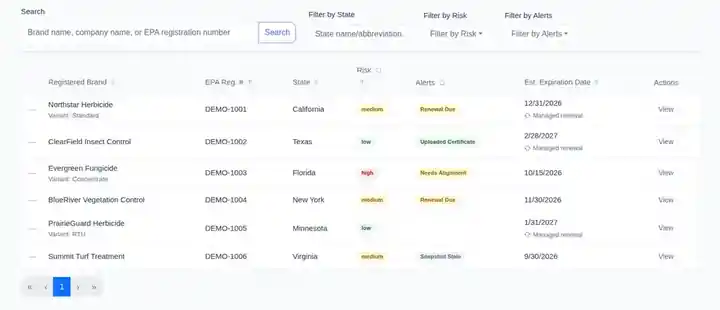
State registration is not a one-time event. Renewal cycles, agency records, product changes, and regulatory developments can create new work after approval. USAPR helps companies keep the important records connected and periodically review what may need attention across a Brand’s State registration footprint.
How monitoring works today
Periodic review with human judgment
USAPR monitoring is designed around scheduled review, organized records, and meaningful follow-up. It should not be interpreted as continuous real-time surveillance, automatic legal determination, or a guarantee that every external change will be detected immediately.
What stays in view
Monitoring starts with the compliance records you already have
The goal is not to create another disconnected alert feed. Monitoring is most useful when new observations can be compared with the registrations, renewal dates, documents, agency correspondence, and prior decisions already associated with the product.
Registration standing
Periodically review available state evidence against the registration record and surface discrepancies or items that need confirmation.
Renewal readiness
Keep renewal timing, prior submissions, current product records, and unresolved agency follow-up visible before the next filing cycle begins.
Regulatory developments
Review source-supported regulatory updates and enforcement developments for changes that may deserve portfolio-specific attention.
A practical monitoring cycle
Observe, compare, review, and act when something matters
- Maintain the portfolio record — Keep the product, registrant, state registration, renewal, documents, and prior evidence connected.
- Review available evidence — Periodically check appropriate state sources, notices, renewal materials, or other regulatory information.
- Compare against the known record — Identify meaningful differences, missing confirmations, upcoming work, or developments that may affect the portfolio.
- Apply human review — Distinguish routine noise from a discrepancy or regulatory development that deserves attention.
- Create the next action — Route the result into renewal, correction, agency follow-up, research, or another deliberate compliance task.
What may deserve attention
A useful monitoring signal should lead to a clear question
- Does a state record still match the registration we expect to be active?
- Is a renewal cycle opening, approaching, or awaiting confirmation?
- Has a product, registrant, Brand, label, or company relationship changed?
- Is an agency response, deficiency, or correction still unresolved?
- Has a state announced a new form, fee, portal, deadline, or process?
- Does a regulatory update appear relevant to products or states in the portfolio?
- Does enforcement activity reveal an emerging compliance issue worth reviewing?
- Is there conflicting evidence that requires a person to verify the correct status?
Calm by design
Not every observation should become an alarm
Compliance teams need prioritization, not a wall of notifications. USAPR is designed to preserve the evidence, indicate uncertainty when it exists, and make the next meaningful action easier to understand.
One understandable state
Present the most useful current status rather than forcing users to interpret multiple competing alerts.
Evidence before escalation
Keep source and observation context attached so a discrepancy can be reviewed before it becomes a compliance conclusion.
Human authority
Technology can organize and compare information. Regulatory interpretation and consequential actions remain deliberate human decisions.
Monitoring boundaries
Monitoring supports compliance work; it does not replace regulatory judgment
USAPR does not represent periodic monitoring as continuous surveillance or automatic legal advice. Source availability varies by jurisdiction, agency records may lag, and some changes require direct confirmation or specialized interpretation.
Part of Product Compliance Monitoring
Use the right capability for the question
This page covers recurring State registration monitoring. Federal product status belongs in EPA Registration Monitoring. Transaction-level product, restricted-use, dealer, and applicator checks belong in the Compliance API.
EPA Registration Monitoring
Keep recurring federal product status observations, history, and alerts connected to the Brand.
Compliance API
Review product status, State controls, dealer licensing, and applicable applicator credentials in supported transaction workflows.
Connected operations
Registration, renewal, and monitoring should reinforce each other
A completed registration creates evidence and dates. A renewal refreshes the record. Monitoring uses that history to make later review more useful. The more consistently the records stay connected, the less often a compliance team has to reconstruct what happened from spreadsheets and inboxes.
State Registrations
Organize new state filings and preserve the resulting registration evidence.
State Renewals
Reconcile the portfolio, complete the current cycle, and carry the updated record forward.
Public Workspace and My Workspace
Public information explains the requirement. Your workspace applies it to your portfolio.
The Regulatory Library provides public state guidance, official resources, and reviewed regulatory developments. My Workspace is where customer-specific Brands, registrations, renewal work, documents, evidence, observations, and next actions can be organized together.
State Registration Monitoring
Build a State registration record that remains useful between filing cycles
USAPR combines organized State-registration operations with periodic monitoring and human review so teams can see what changed, what is uncertain, and what deserves action without rebuilding the history each time.