Registrant / manufacturer
Product registration, labeling, classification, or program-specific responsibilities.
Restricted & Controlled Pesticides
Federal Restricted Use Pesticide classification is only one layer. States may impose additional classifications or controls affecting sale, purchase, shipment, possession, application, supervision, permits, training, records, or reporting. USAPR organizes these programs into source-backed State guidance.
Illustrative structure only. The applicable actors and obligations depend on the State program.
Why the terminology is broader
USAPR uses “Restricted & Controlled Pesticides” as an umbrella topic because States may organize additional controls under different names and structures.
Who may be affected
The relevant actor depends on the State program and the activity involved. State guidance may identify obligations for different participants in the product lifecycle.
Product registration, labeling, classification, or program-specific responsibilities.
Licensing, sale, shipment, storage, display, or purchaser-verification duties.
Credentials, permits, purchase conditions, or other State-defined eligibility requirements.
Certification, endorsements, supervision, training, use conditions, records, or reporting.
Types of obligations
Depending on the program, public guidance may describe product authorization, commercial licensing, applicator certification, permits, purchaser verification, sale or shipment controls, use restrictions, recordkeeping, and reporting.
Broad qualification factors
State programs may consider product identity, labeled activity, geography, timing, quantity, or another State-defined factor. Public pages explain reviewed criteria at a human-readable level; they do not expose internal matcher logic.
Public information boundary
Public State pages may explain classifications, affected actors, obligation categories, broad qualification factors, official sources, and current coverage. They do not determine whether a particular product is classified, whether a seller or purchaser is eligible, whether a shipment is permitted, or whether a transaction is authorized.
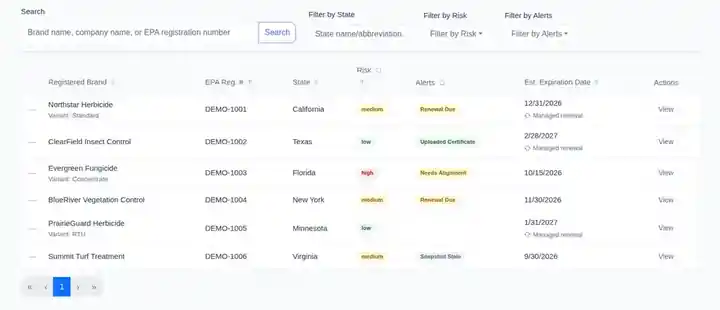
State guidance
Each jurisdiction retains its own terminology, program details, actors, obligation categories, and official sources. Coverage is expanded and reviewed State by State.
Official federal context
EPA maintains federal Restricted Use Pesticide information and applicator-certification guidance. State programs may add their own requirements, so applicable State agency sources should also be reviewed.
Need help organizing State requirements?
For product-specific questions, USAPR starts with the applicable State sources and the customer’s actual portfolio context.
Tell us what you are working on. We will help identify the clearest next step.